Showing posts with label Ingredients. Show all posts

Wednesday, November 30, 2011

Secret Santa Stout: The ingredients

Deciding to brew Secret Santa Stout was the result of a not-terribly-scientific survey of dark, high-gravity beers. After brewing an amber ale for my inaugural batch, I knew I wanted to go darker for the second. I've always been a fan of maltier beers, so it made sense to try a porter or a stout. I also wanted to add fresh ingredients this time, whether in the boil or in the fermenter, so I thought about flavors like coffee, chocolate, and vanilla -- or maybe even something daring like cinammon or hot pepper. Ultimately, caution won out, and I stuck with a kit, but one that includes most of what I'm looking for.

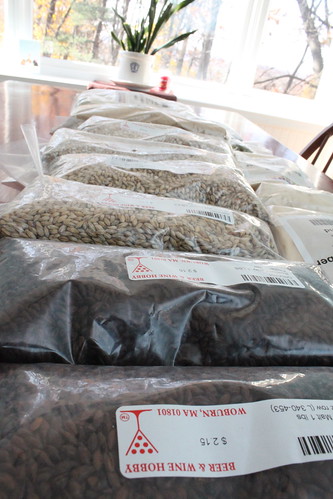
Secret Santa Stout is made from the "bourbon vanilla oak stout" kit from Beer and Wine Hobby. The kit includes:
  • 2 lb flaked oats 
  • 1 lb chocolate malt 
  • 1 lb roasted barley 
  • 2 lb Munich malt 
  • 3 lb light dry malt extract 
  • 3 lb dark dry malt extract 
  • 2 lb amber dry malt extract 
  • 2 oz Galena hop pellets 
  • 1 oz Golding hop pellets 
  • 4 oz French oak chips 
  • English ale yeast

Despite being an extract kit, the shipment includes 6 pounds of grains for steeping, which is important. I'm not philosophically opposed to the ease of extracts. I can't see myself ever going to all-grain brewing, or even a partial mash that would require a lauter-tun. That all sounds too much like work to me. But I do want to introduce quality ingredients wherever I can. Two of the key ingredients in the kit's name, the bourbon and the vanilla, are not included, and that's part of what attracted me to the recipe. Anything fresh that I can add will make a big difference.

The recipe required a little prep work prior to the boil. The first thing I had to do was soak the wood chips in bourbon. I put them in a small, airtight container, and poured Knob Creek bourbon to cover (about 300 ml). The wood is to soak for a week. Even after a few days, it's already absorbed a decent amount of liquid. At first the chips were completely submerged, and now the top layer is visibly above the bourbon's surface. This pleases me.

The wood will be used later in the fermenting process to approximate aging the beer in a bourbon casket. First, though, comes the boil.

Wednesday, January 12, 2011

8-Bit Ale brewing begins

In the days leading up to my first attempt at a homebrew, my time was divided thusly:
  • 40% worrying about technique
  • 20% fantasizing about hops and malt
  • 40% thinking of a name for my beer
On the name, at least, I'm pretty confident. I wanted something related to video games, and something that rolled off the tongue. "8-Bit Ale" fit the bill nicely. Seriously, say it out loud. "8-Bit Ale." Good, right? You want to drink it already.

Of course, the recipe I'd be following is one that thousands of other homebrewers had used. It's the one that comes with the homebrewing kit I got for Christmas, which was furnished by the fine folks at Beer and Wine Hobby in Woburn, MA. The kit included most of the equipment I needed. In reading the recipes, and Charlie Papazian's book, it seemed the major component I was missing was a stock pot big enough to boil my wort. The night before I was set to begin, I picked up a 20-quart stainless steel pot from Target, and got ready to brew.

8-Bit Ale was to be an "amber ale," one of three options included in the deluxe homebrewing kit from Beer and Wine Hobby. The ingredients were as follows:
  • 2 cans malt extract (3.3 lbs each)
  • 1 lb crystal malt
  • 1.5 oz Hallertau hop pellets
  • .5 oz water salts
  • 15g yeast
To this, I would need to add 5 gallons of water. Thus began a recurring theme in my homebrewing experience: excessive worrying about possibly trivial things. Apparently master brewers take their water seriously, and make sure that the mineral content of the water is just so in each and every brew they make.

I thought about picking up some filtered water from the store, and I considered trying to filter 5 gallons through my Brita pitcher (which would only have taken about six hours or so), before deciding that I had enough to worry about, so I should use tap water. I mean, come on -- I drink my tap water all the time and I haven't turned into the Toxic Avenger yet. Let's just get started.

But, as I said, questions kept coming up. Remember when you were a kid and you were starting at a new school, there were a million things to think about, but the most important thing you were concerned about was where the bathroom was? That's how I felt when I started my batch of 8-Bit Ale. I was fascinated by the interplay of ingredients, by the chemical reactions that I would be orchestrating, and by the control I could finally exert over the beer that I would drink. When it came to the most basic logistical questions. I was terrified.

I wondered things like:
  • Should I cover the stock pot when it's boiling, or leave it uncovered?
  • How often should I stir it?
  • Where will I sanitize my bucket?
  • If I use the bucket for fermentation, what will I use to bottle?
  • What the hell is "sparging?"
Just as in school, when you finally had to raise your hand and ask for the damn hall pass, eventually I needed to get started. You learn by doing, not by reading the first chapter of The Complete Joy of Homebrewing over and over.

It was time to get started.