Let me say first that having a successful brew under my belt made a huge difference in my attitude toward the second one. When I started brewing 8-Bit Ale, I was so keyed up that I couldn't even focus. I don't know why; it's just how I am. I was so desperate for everything to go right that I was ensuring that it wouldn't. Having had that experience, I approached Secret Santa Stout with a comparatively Buddha-like calmness.
This recipe doesn't ask for anything more advanced, technique-wise, than the last one. It just has a lot more ingredients. The whole thing starts with the steeping of some grains. The included grains -- chocolate malt, Munich malt, and roasted barley -- needed to be cracked before use. I poured them, little by little, into a large plastic freezer bag, and then attacked them with a rolling pin. Charlie Papazian recommends not pulverizing the grains. You're just looking to breach the husks. It was hard to tell how I did on this score, because there were plenty of fine particles left over, but no reason to sweat it.
When all of them were cracked, I tied them into a (very heavy) muslin bag. I poured the flaked oats into another muslin bag and tied it off. Then I filled my brew pot with two gallons of water and added the grains. I turned on the heat, and brought it up to temperature. I never did replace the broken thermometer from the last time, so I'm still using a meat thermometer to measure the temperature of my water. I'm not sure how accurate the reading is, since it only goes a few inches into the water, but I tried to stir the water around the bags occasionally in order to evenly distribute the water. When the reading reached 150 degrees F, I turned off the heat, covered the pot, and steeped for 30 minutes.
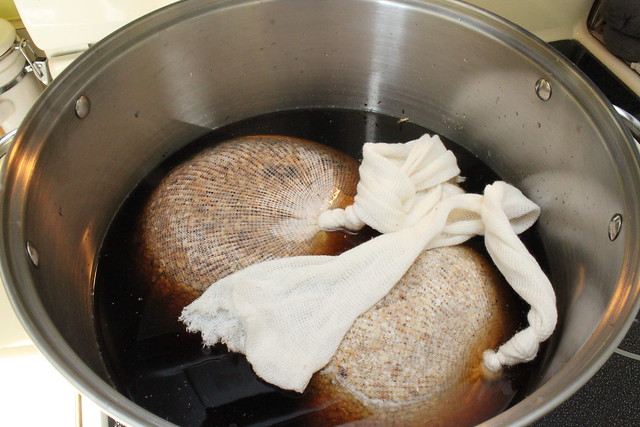
After that, I was supposed to add the malt extracts and the Galena hops, but we realized we needed some things at the grocery store -- in particular, a replacement thermometer. See, our digital thermometer went bonkers, giving readings in both Fahrenheit and Celsius, and refusing to turn off. In attempting to open up the battery compartment, we ended up breaking the whole thing. So it was off to the store. I removed the grains from the pot first, but let the tea sit on the stove, covered, for another 30 minutes or so until we got back.
At that point, I added the malt and the boiling hops. Unlike last time, I used a dry malt extract instead of a syrup. Dry was definitely easier to work with, since I didn't have all the prep work of soaking it in hot water and then spooning it out. But it did form big, sticky clumps in the water that took a few minutes of heating to dissolve. I have no idea how dry extracts compare to syrups in terms of the finished product, but as a lazy homebrewer I will say that I definitely prefer the powdered version.
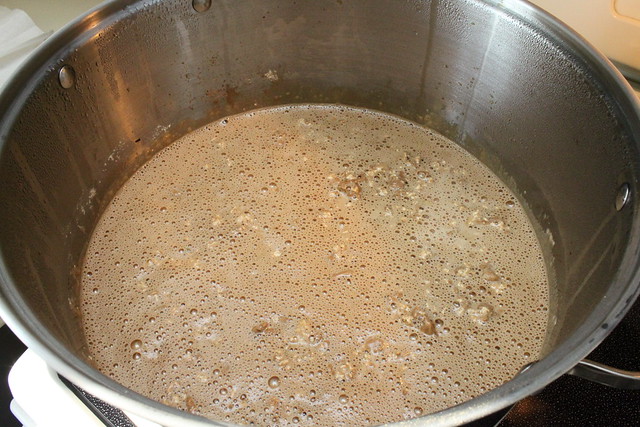
As before, I'm using pre-measured hop pellets, not whole hops. Not much to say there. You just cut open the plastic package and dump them in. Couldn't be easier. After boiling with the Galena hops for 45 minutes, I added the Golding hops for the final 15 minutes. Although I chose this recipe for its maltiness, I was surprised to realize that it's actually much hoppier than the amber ale I brewed last winter. Doubly so, in fact -- 3 ounces, compared to 1.5! That's part of the reason I'm so excited about the recipe. There's a lot more going on.
After an uneventful boil, the step was one that had caused me much frustration the last time: cooling the wort and pitching the yeast. Would I have learned my lesson?
Showing posts with label How to Boil Wort. Show all posts
Friday, December 2, 2011
Secret Santa Stout: The boil
Friday, January 14, 2011
Wort, me worry?
All things being equal, I thought the first part of brewing my 8-Bit Ale went very well. First, I added 1.5 gallons of water to my 20-quart stock pot. (Tap water, as mentioned in the last post.)
Next, I poured the 1 pound of crystal malt into a muslin bag and knotted it. I dropped it into the stock pot and turned on the heat.
I brought the water to a boil, then removed it from the heat and let the malt steep for five minutes. Apparently you can check the temperature during this part of the process to make sure that you're getting everything right, but, again, I decided not to sweat it.
I was a little worried because the bag was only about halfway submerged in the water, and because lots of fine powder had escaped the bag in the transition from the counter to the pot. But before long, a dark toffee color was seeping from the bag into the water, and a rich sweet smell was permeating the air. The most interesting thing that happened during this step was that the grains started to pop under the heat, almost like popcorn.
While this was going on, I filled the sink with warm water and stuck my cans of malt extract in for a few minutes. Papazian had recommended this as a way to make the syrup easier to work with.
He was right! The stuff was incredibly thick. And sweet, too, as I noticed when I sucked a bit of it off my fingertips.
Next, I removed the grains from the pot, and added the syrup, the hop pellets, and the water salts.
The next stage was time-consuming, but easy. I simply boiled the concoction for 45 minutes. (The instructions I got with the kit said to boil for 30 minutes, but Papazian said 45, and in this case I chose to follow his advice. Later, I would learn that I should always follow his advice.)
During this time, I was blown away by the aroma. The dominant scent was a malty sweetness, girded by an earthy grain odor.
I was surprised by how many visible changes the wort went through while I was boiling it. At first, the hop pellets disintegrated and floated on the surface. After a little while, the wort formed a thick greenish coating that looked like pond scum. Then it disappeared, and for the last half or so of the boiling process the wort took on a deep caramel color.
The questions persisted: What does it mean to boil for 45 minutes? Do I want a violent boil, or more of a simmer? They don't tell you this stuff. For the most part I went with a rolling boil, but it was dangerous. At times, the liquid level surged nearly to the top of the pot, and only judicious stirring and alert heat control prevented it from boiling over.
During this time, I asked my wife to watch over the wort while I attended to some sanitization. I needed to clean my fermentation bucket, the lid, and everything else that would come into contact with the wort once it came off the heat. This wasn't too hard, although, again, I worried about the details. My kit came with something called "C-Brite." I had to mix one packet of it with a gallon of water. Seemed easy enough to do this in my fermentation bucket, and then sanitize the smaller equipment right in there. But what was I supposed to do?
I ended up dunking the equipment in the cleaning solution for several seconds, swishing it around to make sure every bit of the surface was sanitized. Then I rinsed it all under cold tap water and laid it out on paper towel. For the bucket itself, I grabbed some more paper towels that I sloshed into the solution, then up and around the walls of the bucket. I only did the top part of the outside, figuring the beer wouldn't and shouldn't come into contact with much of the bucket's exterior. Maybe this will end up poisoning me.
All told, I was happy with the way this part of the process unfolded. Everything seemed to go right. I added the ingredients at the right time; I sanitized everything, maybe even more than I needed to. So far, my first batch of homebrew was shaping up nicely. I could almost taste the 8-Bit Ale.
And that's when everything started to go wrong.
Next, I poured the 1 pound of crystal malt into a muslin bag and knotted it. I dropped it into the stock pot and turned on the heat.
I brought the water to a boil, then removed it from the heat and let the malt steep for five minutes. Apparently you can check the temperature during this part of the process to make sure that you're getting everything right, but, again, I decided not to sweat it.I was a little worried because the bag was only about halfway submerged in the water, and because lots of fine powder had escaped the bag in the transition from the counter to the pot. But before long, a dark toffee color was seeping from the bag into the water, and a rich sweet smell was permeating the air. The most interesting thing that happened during this step was that the grains started to pop under the heat, almost like popcorn.
While this was going on, I filled the sink with warm water and stuck my cans of malt extract in for a few minutes. Papazian had recommended this as a way to make the syrup easier to work with.
He was right! The stuff was incredibly thick. And sweet, too, as I noticed when I sucked a bit of it off my fingertips.Next, I removed the grains from the pot, and added the syrup, the hop pellets, and the water salts.
The next stage was time-consuming, but easy. I simply boiled the concoction for 45 minutes. (The instructions I got with the kit said to boil for 30 minutes, but Papazian said 45, and in this case I chose to follow his advice. Later, I would learn that I should always follow his advice.)During this time, I was blown away by the aroma. The dominant scent was a malty sweetness, girded by an earthy grain odor.
I was surprised by how many visible changes the wort went through while I was boiling it. At first, the hop pellets disintegrated and floated on the surface. After a little while, the wort formed a thick greenish coating that looked like pond scum. Then it disappeared, and for the last half or so of the boiling process the wort took on a deep caramel color.
The questions persisted: What does it mean to boil for 45 minutes? Do I want a violent boil, or more of a simmer? They don't tell you this stuff. For the most part I went with a rolling boil, but it was dangerous. At times, the liquid level surged nearly to the top of the pot, and only judicious stirring and alert heat control prevented it from boiling over.During this time, I asked my wife to watch over the wort while I attended to some sanitization. I needed to clean my fermentation bucket, the lid, and everything else that would come into contact with the wort once it came off the heat. This wasn't too hard, although, again, I worried about the details. My kit came with something called "C-Brite." I had to mix one packet of it with a gallon of water. Seemed easy enough to do this in my fermentation bucket, and then sanitize the smaller equipment right in there. But what was I supposed to do?
I ended up dunking the equipment in the cleaning solution for several seconds, swishing it around to make sure every bit of the surface was sanitized. Then I rinsed it all under cold tap water and laid it out on paper towel. For the bucket itself, I grabbed some more paper towels that I sloshed into the solution, then up and around the walls of the bucket. I only did the top part of the outside, figuring the beer wouldn't and shouldn't come into contact with much of the bucket's exterior. Maybe this will end up poisoning me.
All told, I was happy with the way this part of the process unfolded. Everything seemed to go right. I added the ingredients at the right time; I sanitized everything, maybe even more than I needed to. So far, my first batch of homebrew was shaping up nicely. I could almost taste the 8-Bit Ale.
And that's when everything started to go wrong.
Subscribe to:
Posts (Atom)

